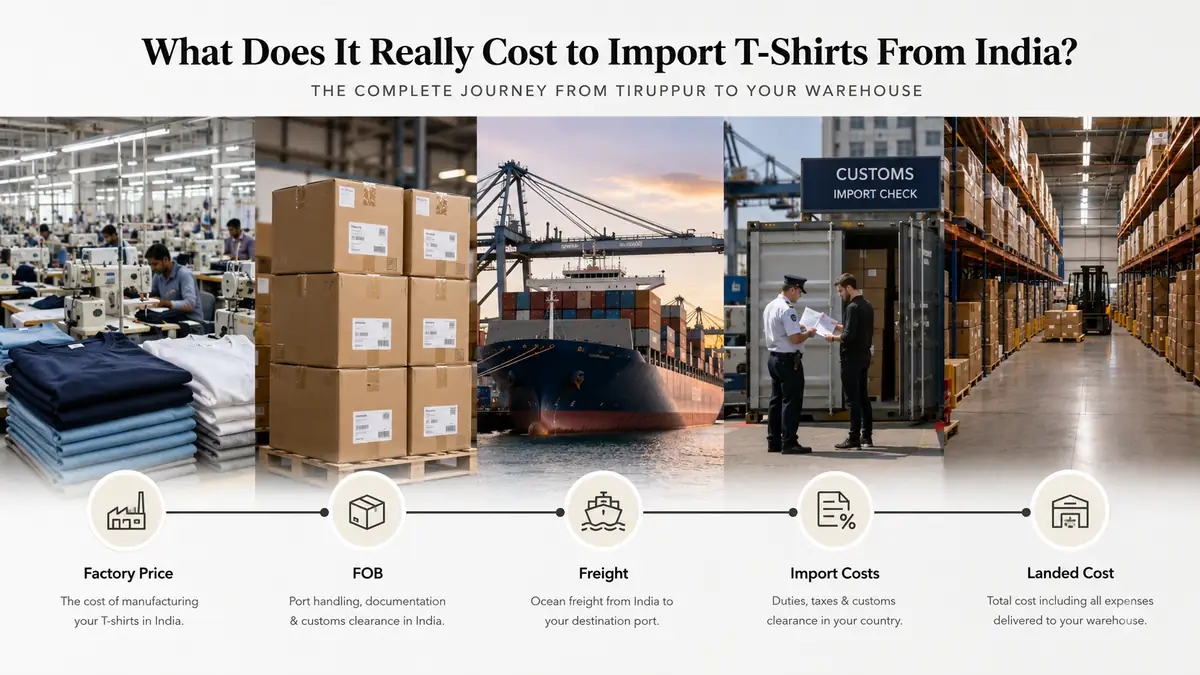
If a T-shirt manufacturer in India quotes you $5 per piece, is your actual cost $5?
Not necessarily.
For an international clothing brand, the factory quotation is only one part of the total cost. Freight, insurance, customs duties, brokerage, destination charges, inland transportation and other import expenses can significantly change the final landed cost per T-shirt.
This is why international buyers should compare suppliers based on total landed cost, not simply the lowest FOB or factory price.
In this guide, we explain how to calculate the cost to import T-shirts from India, what international buyers should include in their costing sheet, and how order quantity, fabric, shipping method and destination country can affect the final price.
Lorem ipsum dolor sit amet, consectetur adipiscing elit. Ut elit tellus, luctus nec ullamcorper mattis, pulvinar dapibus leo.
What Is the Cost to Import T-Shirts From India?
There is no single import price that applies to every T-shirt shipment.
The final cost depends on:
- T-shirt manufacturing price
- Fabric composition and GSM
- Printing or embroidery
- Custom labels and packaging
- Order quantity
- Incoterm
- Origin charges
- International freight
- Cargo insurance
- Import duty
- Customs clearance
- Brokerage
- Destination charges
- Inland transportation
- Country-specific taxes and requirements
A useful starting formula is:
Total Landed Cost = Product Cost + Origin Costs + Freight + Insurance + Import Costs + Destination Costs
Then:
Landed Cost Per T-Shirt = Total Landed Cost ÷ Sellable Quantity
This is the number an importer should ultimately use when calculating margins.
Factory Price vs FOB Price vs Landed Cost
These three numbers are often confused.
Factory or manufacturing price
This is the amount associated with producing the garment.
It may cover items such as:
- Fabric
- Cutting
- Stitching
- Printing
- Washing
- Finishing
- Basic packing
The exact inclusions depend on the quotation.
FOB price
FOB is a trade term that defines the seller’s responsibilities up to the agreed point of shipment. The exact commercial terms should always be confirmed in the quotation and purchase contract.
For an international apparel buyer, an FOB quotation is useful-but it is not the same as the cost delivered to your warehouse.
Landed cost
Landed cost is the broader number.
It represents what the imported garments actually cost your business after adding the relevant logistics, import and destination expenses.
For serious apparel importers, landed cost is the number that should drive margin calculations.
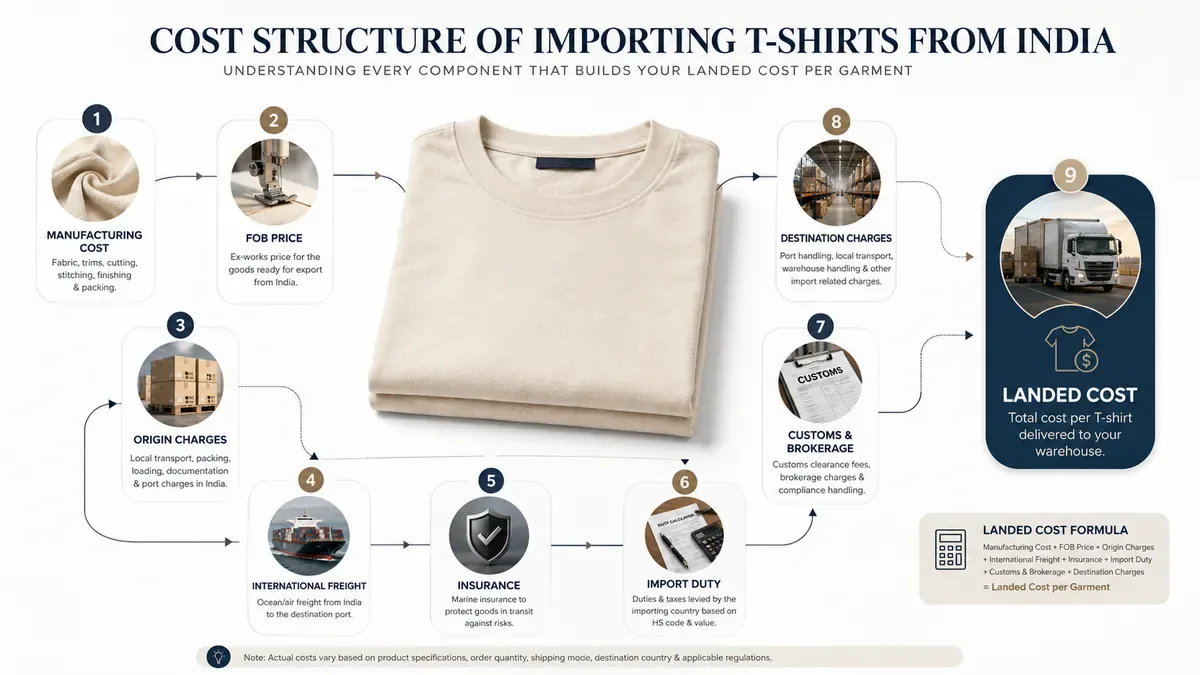
A Simple Example: Importing 1,000 T-Shirts From India
Suppose a brand wants to import:
Assume the negotiated FOB price is:
$5.00 per T-shirt
The initial product value is therefore:
1,000 × $5 = $5,000
But the buyer should not immediately assume that the shipment will cost $5,000.
An illustrative costing structure could look like this:
| Cost component | Example |
|---|---|
| FOB garment value | $5,000 |
| Origin/export charges | $XXX |
| International freight | $XXX |
| Cargo insurance | $XX |
| Import duty | Depends on destination |
| Customs/brokerage | $XXX |
| Destination/port charges | $XXX |
| Inland delivery | $XXX |
| Total landed cost | $X,XXX |
| Landed cost per T-shirt | $X.XX |
The figures above are intentionally shown as variables because freight, duty and destination charges are not universal.
The important lesson is that the $5 FOB price is not the final cost.
What Costs Should International Buyers Include?
1. T-Shirt Manufacturing Cost
The starting point is the garment itself.
The price can change substantially depending on:
- 100% cotton vs blended fabric
- Yarn specification
- GSM
- Fabric construction
- Custom dyeing
- Garment washing
- Printing
- Embroidery
- Pattern complexity
- Fit
- Labels
- Packaging
- Order quantity
A 180 GSM basic cotton T-shirt and a 240 GSM oversized streetwear T-shirt should not be expected to have the same manufacturing cost.
Your specifications should therefore be finalized before comparing quotations.
For a deeper look at manufacturing economics, see Texora’s guide to T-shirt manufacturing cost in India.
2. Sampling and Product Development
International buyers should also consider development costs.
A custom garment may require:
- Fabric swatches
- Fit samples
- Pattern development
- Print development
- Embroidery development
- Custom dyeing
- Label development
- Pre-production samples
The first sample can cost considerably more than the eventual bulk garment because development work is being performed for a small quantity.
A professional buyer should therefore distinguish between:
and
3. Export and Origin Charges
Depending on the shipment structure, there can be costs associated with:
- Export documentation
- Origin handling
- Transportation to the port
- Freight forwarding
- Container or consolidation charges
- Port-related services
Indian export documentation can include commercial invoices, packing lists, bills of lading or airway bills, certificates of origin and other documents depending on the shipment and destination. India’s Directorate General of Foreign Trade notes that documentation varies according to the destination and product.
These costs should be clarified before the purchase order is finalized.
4. International Freight
Shipping can become a significant part of the cost, particularly for smaller apparel orders.
The main options are generally:
Sea freight
Usually more economical for larger shipments, but slower.
Air freight
Faster, but generally much more expensive per kilogram.
Courier
Useful for samples and very small shipments, but usually not appropriate for regular bulk apparel imports.
For a 1,000-piece order, the freight cost per T-shirt can be considerably higher than for a larger shipment because fixed logistics expenses are distributed across fewer garments.
This is one reason why buyers should compare landed cost per unit, not just freight as a total number.
5. Import Duty and Taxes
This is where many first-time importers make mistakes.
Import duty is not simply a universal percentage applied to every T-shirt.
It can depend on:
- Destination country
- HS classification
- Fibre composition
- Garment construction
- Country of origin
- Applicable trade agreements
- Current tariff measures
- Importer status
- Other local regulations
For example, U.S. Customs rulings classify knitted T-shirts under heading 6109, with sub-classification depending on factors including fibre composition. A cotton T-shirt and a synthetic-fibre T-shirt can therefore have different tariff treatment.
Never calculate your import cost using an old tariff figure found in a random blog.
Before placing a substantial order, confirm the applicable tariff classification and current duty treatment with your customs broker or relevant customs authority.
6. Customs Clearance and Brokerage
Your shipment may also incur destination-side costs such as:
- Customs broker fees
- Entry processing
- Documentation charges
- Port or terminal charges
- Examination-related charges where applicable
- Handling
- Storage
- Delivery appointment charges
These costs can be especially important for smaller shipments because fixed charges are spread across fewer units.
A $200 destination charge has a very different impact on:
500 T-shirts
versus:
10,000 T-shirts.
7. Inland Delivery to Your Warehouse
Your landed cost isn’t necessarily complete when the container leaves the port.
You may still need to pay for transportation from the port or airport to:
- Warehouse
- Distribution centre
- 3PL
- Fulfilment centre
- Retail facility
For ecommerce brands, this final transportation step can be particularly important because the garments may need to move through a third-party logistics network before reaching customers.
How Order Quantity Changes Your Import Cost
MOQ affects more than the factory price.
It can also change your logistics economics.
Imagine two buyers:
Buyer A: 500 T-shirts
Buyer B: 10,000 T-shirts
Even if Buyer B doesn’t receive a dramatically lower factory price, they may achieve a better landed cost because fixed costs such as freight handling, documentation, brokerage and other charges are distributed across more garments.
This creates an important sourcing principle:
The cheapest unit price does not always produce the lowest landed cost.
Likewise, ordering more than you can realistically sell is not automatically a smart decision.
The right quantity balances:
unit economics + inventory risk + cash flow + demand.
Does Fabric Affect the Cost to Import T-Shirts?
Yes.
Fabric choice affects both manufacturing cost and, in some markets, tariff classification.
Consider:
- 100% cotton
- Cotton/polyester blends
- Cotton/spandex
- Polyester
- Organic cotton
- Different GSM levels
- Different knit constructions
A heavier T-shirt may require more fabric per garment.
A specialized finish may increase processing costs.
A custom-dyed fabric may require a different production quantity.
And the fibre composition can affect tariff classification in some destination markets. U.S. Customs rulings provide examples where cotton and man-made-fibre T-shirts fall under different tariff provisions.
So when calculating the cost to import T-shirts, don’t treat every T-shirt as an identical commodity.
USA, UK and European Buyers: Don't Use One Import Formula
An importer in the United States, United Kingdom, Germany or Australia should not simply copy another buyer’s import calculation.
Each destination can have different:
- Tariff schedules
- Taxes
- Customs procedures
- Product classifications
- Documentation
- Trade agreements
- Import requirements
This is particularly important in 2026 because international apparel trade conditions are changing. India’s apparel exports continue to be influenced by tariff and trade-policy developments, while European and UK markets remain important destinations for Indian apparel.
For that reason, an accurate quotation should always be prepared around the actual destination country and product specification.
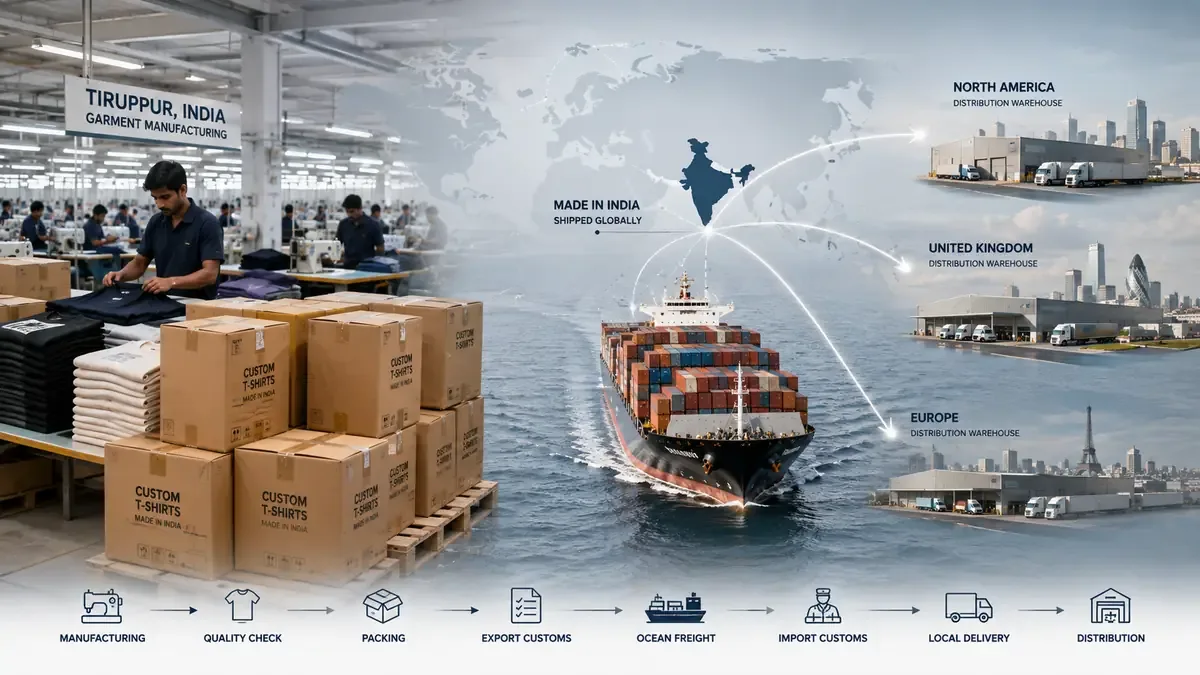
A Better Way to Compare Indian T-Shirt Suppliers
Suppose you receive three quotations:
| Supplier | FOB Price |
|---|---|
| Supplier A | $4.70 |
| Supplier B | $5.00 |
| Supplier C | $5.30 |
It is tempting to select Supplier A.
But what if Supplier A has:
- Higher freight
- More expensive packaging
- Higher defect rates
- Poor production consistency
- Higher sampling costs
- Longer lead times
while Supplier C provides a more predictable production program?
The correct comparison is:
Supplier → FOB → Freight → Duty → Destination Charges → Landed Cost → Quality → Sellable Units
This is why experienced importers evaluate suppliers on total sourcing economics, not just the headline garment price.
What Should You Ask an Indian T-Shirt Manufacturer?
Before requesting a quotation, provide:
- Product type
- Reference image or tech pack
- Fabric composition
- GSM
- Colour
- Size range
- Quantity
- Printing requirements
- Embroidery requirements
- Labels
- Packaging
- Destination country
- Required delivery date
- Preferred shipping method
Then ask the manufacturer:
- What is the FOB price?
- What does the price include?
- What is the MOQ?
- What is the sample-development cost?
- What is the bulk production lead time?
- Can you source the required fabric?
- Can you provide custom colours?
- What printing and embroidery methods are available?
- What quality inspection process is followed?
- Which export documents will be provided?
The more complete your specification, the more useful the quotation will be.
How to Calculate Your True Import Cost
Before approving an order, build a costing sheet with these categories:
Product
→ T-shirt manufacturing
→ Labels
→ Packaging
→ Printing/embroidery
→ Washing/finishing
Origin
→ Inland transport
→ Export documentation
→ Origin handling
International
→ Freight
→ Insurance
Destination
→ Import duty
→ Taxes
→ Customs brokerage
→ Port/terminal charges
→ Inland transportation
Then calculate:
Total landed cost ÷ sellable quantity = landed cost per T-shirt
This gives you a much better number for determining your wholesale price, ecommerce price and gross margin.
Final Takeaway: Look Beyond the Factory Quote
If you’re researching the cost to import T-shirts from India, don’t make your sourcing decision based on the factory price alone.
A $5 T-shirt is not necessarily a $5 product for your business.
The real number is the landed cost after manufacturing, freight, insurance, import charges, customs clearance and delivery.
India remains a significant apparel sourcing market, and international buyers continue to evaluate India alongside other major manufacturing destinations. Indian apparel exports are particularly exposed to the U.S. and European markets, making accurate international costing increasingly important for brands planning their sourcing strategy.
At Texora Sourcing, buyers can discuss their T-shirt specifications, quantity, fabric requirements, customization and destination country to develop an export-oriented production quotation.
Looking for a T-shirt manufacturer in India?
Share your product requirements with Texora Sourcing and request a quotation based on your actual production program.

Quick Cost-to-Import Checklist
Before placing your order, confirm:
- ✓ FOB garment price
- ✓ Fabric and GSM
- ✓ Printing/embroidery
- ✓ Labels and packaging
- ✓ MOQ
- ✓ Sample cost
- ✓ Production lead time
- ✓ Origin charges
- ✓ Freight
- ✓ Insurance
- ✓ HS classification
- ✓ Import duty
- ✓ Customs/brokerage
- ✓ Destination charges
- ✓ Inland delivery
- ✓ Final landed cost per T-shirt
The number that matters isn’t simply what the factory charges. It’s what each sellable T-shirt costs when it reaches your business.