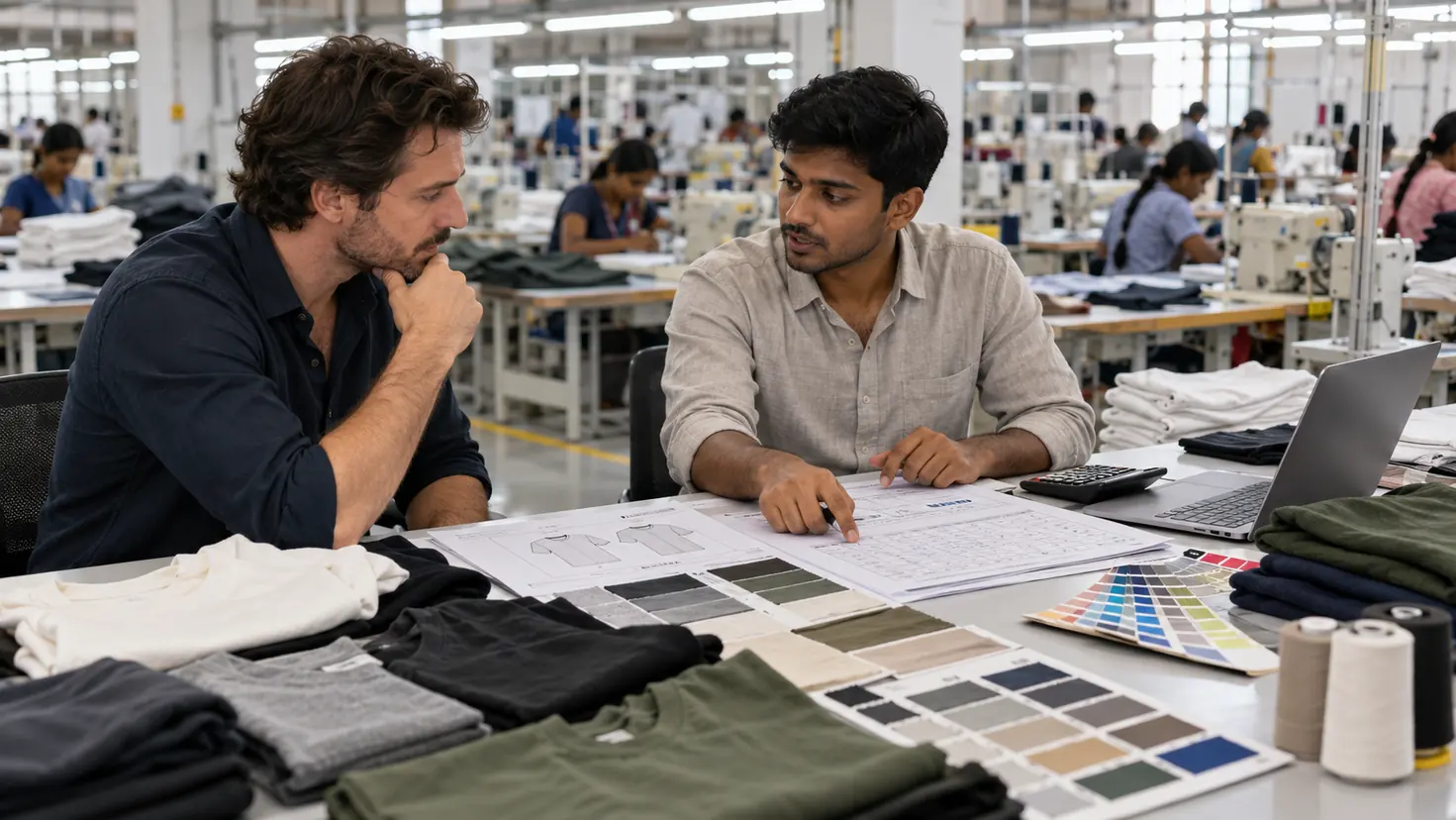
“How much would it cost to manufacture 500 T-shirts?”
It sounds like a straightforward question.
But a professional clothing manufacturer cannot give you a reliable price based on quantity and product name alone.
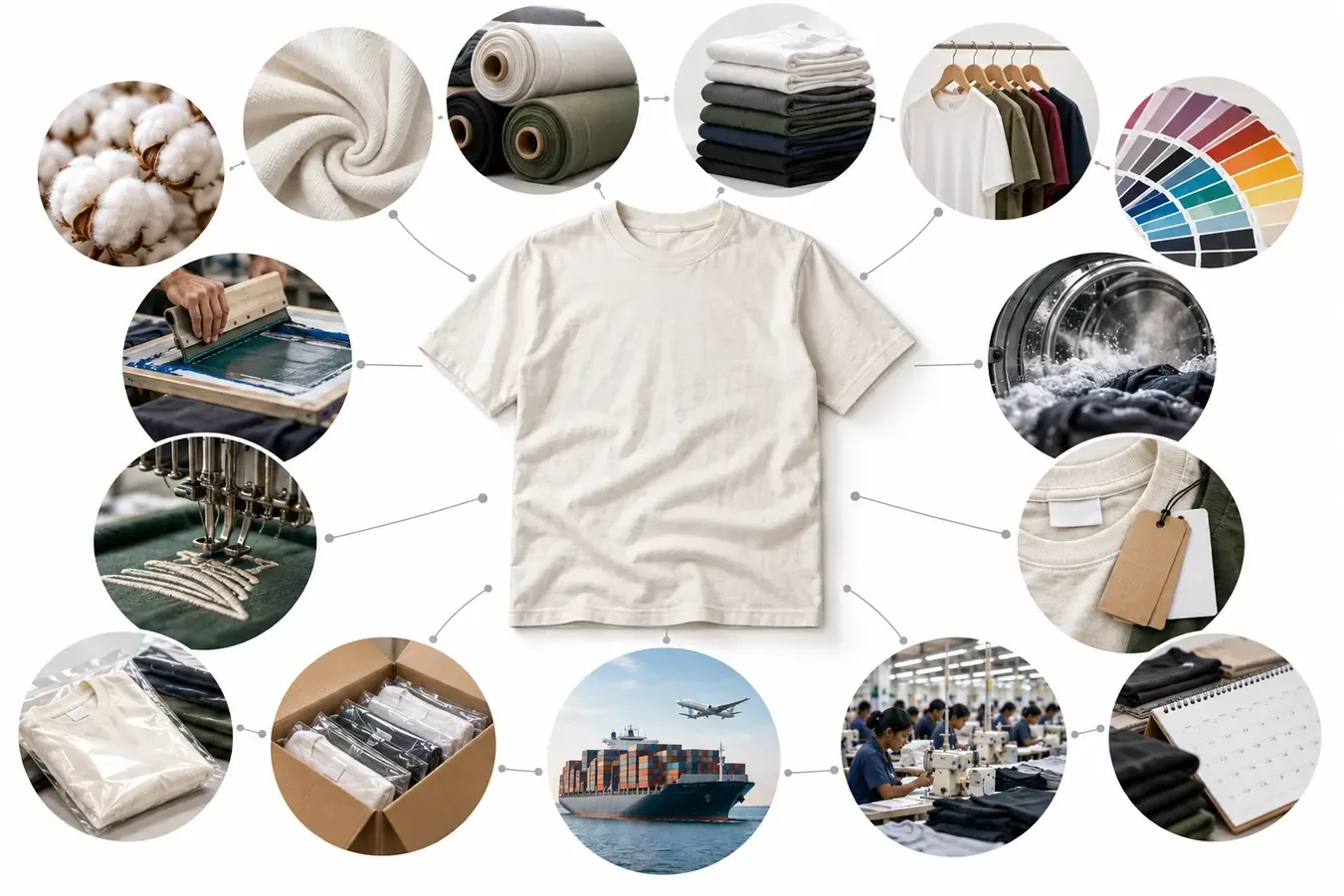
Before preparing a clothing manufacturer quote, the production team needs to understand the fabric, GSM, garment measurements, construction, colour, quantity breakdown, printing or embroidery, washing, labels, packaging, delivery destination and production timeline.
That can sometimes feel like a lot of questions for a simple garment.
But there is a reason.
A manufacturer is not really pricing “500 T-shirts.” They are pricing a specific combination of materials, production processes, labour, finishing and commercial requirements.
The more clearly those requirements are defined, the more meaningful the quotation becomes.
What Is a Clothing Manufacturer Quote Actually Based On?
A clothing manufacturing quote is not simply:
Fabric cost + stitching cost = garment price
The actual calculation can involve many different components:
- Fabric composition and construction
- Fabric GSM
- Fabric consumption
- Dyeing and finishing
- Garment construction
- Cutting and stitching
- Printing or embroidery
- Washing
- Labels and accessories
- Packaging
- Quality requirements
- Order quantity
- Size and colour distribution
- Production timeline
- Shipping or commercial terms
This is why a manufacturer may ask several questions before providing a final price.
A quote based on incomplete information may only be a preliminary estimate. Once the missing specifications are confirmed, the price may need to be recalculated.
For international buyers, this distinction is important: an early estimate and a production-ready quotation are not necessarily the same thing.
Why Can't a Manufacturer Quote From a Photograph?
A reference photograph is extremely useful.
It can show the overall appearance, silhouette, construction details and finishing direction of a garment.
However, a photograph usually cannot tell a manufacturer everything required for costing.
For example, a photograph does not reliably communicate:
- Fabric composition
- Fabric GSM
- Yarn or fabric construction
- Exact garment measurements
- Measurement tolerances
- Fabric finish
- Shrinkage requirements
- Print technique
- Print dimensions
- Embroidery specifications
- Label requirements
- Packaging requirements
A manufacturer can often begin evaluating a project from a photograph, but the quotation becomes more meaningful as the technical information becomes clearer.
This is why a tech pack, specification sheet, reference sample or combination of these documents can significantly improve the quotation process.
A good manufacturer isn’t asking for technical information simply to make the enquiry more complicated. The purpose is to reduce assumptions before production begins.
The Questions Behind a Clothing Manufacturer Quote
Every manufacturer has its own costing process, but the following questions can have a direct effect on the final quotation.
1. What Fabric Do You Need?
“100% cotton” is not a complete fabric specification.
A manufacturer may need to know:
- Composition
- Fabric construction
- GSM
- Yarn specification, where relevant
- Finish
- Colour
- Shrinkage expectations
- Performance requirements
For example, two fabrics can both be 100% cotton and 180 GSM while having different constructions, yarn qualities, finishes and production costs.
If you are unsure about the exact fabric, a manufacturer may recommend an available option based on your target handfeel, appearance, performance and price level.
2. What Is the GSM?
GSM, or grams per square metre, indicates fabric weight.
It is an important input for costing because fabric weight can influence material consumption and the amount of fabric required for a garment.
However, GSM should not be considered the complete fabric specification.
A manufacturer may still need to understand the fabric construction, composition and finish.
This is particularly important for oversized garments, where changes in garment dimensions can also affect fabric consumption.
For example, increasing the body width or length can increase the amount of fabric required per garment even when the GSM remains exactly the same.
This is one reason why a manufacturer cannot determine a final garment price from GSM alone.
3. How Many Pieces Do You Need?
Total quantity is important, but it is not always enough.
Consider these two enquiries:
Order A:
500 T-shirts in one colour
Order B:
500 T-shirts across five colours
The total quantity is identical, but the production requirements can be different.
The manufacturer may also need the expected quantity by:
- Style
- Colour
- Size
The quantity breakdown can affect material planning, colour development, production efficiency and purchasing requirements.
For example, a buyer requesting 1,000 pieces in one colour is providing a very different production program from a buyer requesting 100 pieces each across ten colours.
4. What Is the Size Breakdown?
A manufacturer needs to know whether the order is:
- XS–XL
- S–XXL
- XS–3XL
- Or another size range
The size distribution also matters.
For example, 1,000 garments with an equal size ratio can require a different material plan from 1,000 garments heavily weighted toward larger sizes.
The size chart is also important because garment dimensions influence fabric consumption.
This is why a manufacturer may ask for the complete measurement chart and size ratio before finalizing a quotation.
5. What Colours Do You Need?
Colour requirements can affect both development and production.
A buyer may request:
- An available stock colour
- A Pantone shade
- A custom-dyed colour
- A colour matched to an approved physical standard
Custom colour development can involve additional processes before bulk production.
For international brands, it is therefore useful to specify the colour reference as clearly as possible rather than simply saying “dark blue,” “cream” or “washed black.”
A Pantone reference, approved lab dip or physical colour standard can provide a much clearer target.
6. How Will the Garment Be Decorated?
Printing and embroidery are not simply additional line items added at the end of a quotation.
The decoration method can affect the production process itself.
For example:
- Screen printing
- DTF printing
- DTG printing
- Puff printing
- Embroidery
- Appliqué
The manufacturer may need to know the artwork size, number of placements, technique and location.
A small one-colour chest print is obviously different from a large multi-colour front-and-back print.
The artwork itself can also affect production requirements.
For example, a design with several colours may require a different printing setup from a simple one-colour graphic.
If you are deciding between different decoration methods, our guide to garment printing methods can help explain the differences.
7. Does the Garment Require Washing or Special Finishing?
A garment may require:
- Bio wash
- Silicone wash
- Enzyme wash
- Vintage wash
- Softening
- Other finishing treatments
These processes can affect both the garment’s appearance and its production cost.
They can also affect shrinkage and final measurements.
For example, a buyer may provide a measurement chart based on an unwashed garment but expect the final garment to achieve specific measurements after washing.
That requirement needs to be considered during development.
This is why washing and finishing should ideally be discussed before the quotation and sample are finalized.
8. What Labels and Accessories Are Required?
A clothing manufacturer quote can change depending on the branding and packaging requirements.
For example:
- Main label
- Size label
- Wash-care label
- Hang tag
- Barcode sticker
- Individual polybag
- Custom packaging
- Carton requirements
A quotation that includes standard packaging may not be directly comparable with another quotation that includes custom packaging.
This is one reason buyers should always ask what is included and excluded from the quoted price.
A difference of a few cents or dollars per garment can sometimes come from accessories or finishing requirements rather than the garment itself.
9. Where Will the Order Be Shipped?
The destination market can affect the commercial structure of an order.
An international buyer may request:
- EXW
- FOB
- CIF
- DDP
- Or another agreed commercial arrangement
These terms determine what is included in the quoted price and where responsibility for transportation and other costs changes hands.
For example, an FOB quotation and an EXW quotation should not simply be compared as two garment prices without understanding what each includes.
The manufacturer therefore needs to know the destination and preferred commercial terms when preparing an export quotation.
10. When Do You Need the Order?
Delivery requirements are another reason manufacturers ask questions before giving a final price.
A buyer may say:
“We need the order in 30 days.”
But the manufacturer needs to understand what that actually means.
Does the 30-day period begin:
- From enquiry?
- From sample approval?
- From PPS approval?
- From advance payment?
- From fabric confirmation?
Production planning can involve:
Sample approval → fabric sourcing → dyeing → cutting → printing/embroidery → stitching → washing → finishing → inspection → packing → shipment
If one stage depends on approval from the buyer, the timeline needs to account for it.
This is why a realistic production calendar is often more useful than simply stating a number of days.
Why Two Manufacturers Can Give Different Clothing Manufacturer Quotes
This is one of the most important things an international buyer should understand.
Suppose two manufacturers quote:
Manufacturer A: $6.20 per piece
Manufacturer B: $7.00 per piece
It does not automatically mean that Manufacturer A is cheaper for the same product.
The two manufacturers may be working from different assumptions.
One quotation might include:
- Higher-quality fabric
- Custom labels
- Individual packaging
- Printing
- Washing
- More detailed quality control
While another may exclude some of those requirements.
Even the fabric itself may not be identical.
The correct question is therefore not:
“Which manufacturer gave me the lowest price?”
It is:
“Are both manufacturers quoting exactly the same specification and commercial terms?”
This is particularly important when comparing suppliers across different countries or sourcing models.
A lower quotation can look attractive until you discover that certain requirements were excluded.
What Should a Clothing Manufacturer Quote Include?
A useful quotation should make the pricing basis reasonably clear.
Depending on the project, a buyer should look for information such as:
| Quotation Item | What to Check |
|---|---|
| Product | Exact garment/style |
| Fabric | Composition, construction and GSM |
| Quantity | Total and colour/size breakdown |
| Decoration | Printing/embroidery method |
| Accessories | Labels, tags and packaging |
| Price basis | EXW, FOB or other agreed term |
| Sampling | Whether development/sample costs are separate |
| Lead time | When production lead time begins |
| Payment terms | Advance and balance structure |
| Quote validity | How long the price is valid |
| Exclusions | What is not included |
A quotation becomes much easier to compare when each supplier is pricing the same specification and clearly identifying assumptions.
Why “How Much for 500 T-Shirts?” Is Not Enough
Consider these two enquiries.
Enquiry 1
Hi, I need 500 T-shirts. Please send your best price.
A manufacturer has to ask almost everything.
Now compare that with:
Enquiry 2
Product: Oversized T-shirt
Fabric: 100% cotton
GSM: 220
Colour: Black + custom Pantone colour
Quantity: 500 pcs
Print: Front and back screen print
Sizes: S–XXL
Labels: Custom main label and wash-care label
Packaging: Individual polybag
Destination: United Kingdom
Sample: Required before bulk production
The second enquiry gives the manufacturer a much clearer costing framework.
It doesn’t necessarily mean that every question has been answered, but it gives the sourcing team enough information to begin evaluating the project properly.
For international buyers, this can significantly reduce unnecessary back-and-forth during the initial quotation stage.
What If You Don't Have a Complete Tech Pack?
Not every new brand has a production-ready tech pack.
That doesn’t necessarily mean you cannot approach a manufacturer.
You can start with:
- Reference images
- Product sketches
- Existing garments
- Measurements
- Fabric preferences
- Estimated quantity
- Artwork
- Colour references
- Intended delivery market
The manufacturer can then identify what information is still required for sampling and costing.
However, there is an important distinction:
The less defined the product is, the more assumptions are involved in the initial price.
Once the product is developed and specifications are confirmed, the quotation can be updated accordingly.
For brands developing products from an existing physical garment or reference sample, the development process can also involve pattern creation, measurement analysis, fabric selection and sample revisions.
How International Buyers Can Get a More Accurate Clothing Manufacturer Quote
If you want a useful clothing manufacturer quote, prepare as much of the following as possible:
- Product type
- Reference image or tech pack
- Fabric composition
- GSM
- Colour requirements
- Size range
- Quantity by colour
- Size ratio
- Artwork and decoration requirements
- Labels and packaging
- Washing or finishing requirements
- Required sample
- Target delivery date
- Destination country
- Preferred commercial terms
You don’t necessarily need to have every detail finalized before contacting a manufacturer.
However, providing more information allows the production team to identify the major cost variables much earlier.
It also makes it easier to compare quotations from different suppliers on a like-for-like basis.
A Clothing Manufacturer Quote Is More Than a Price
The best quotation is not necessarily the one with the lowest number.
A useful quotation should tell you what that number represents.
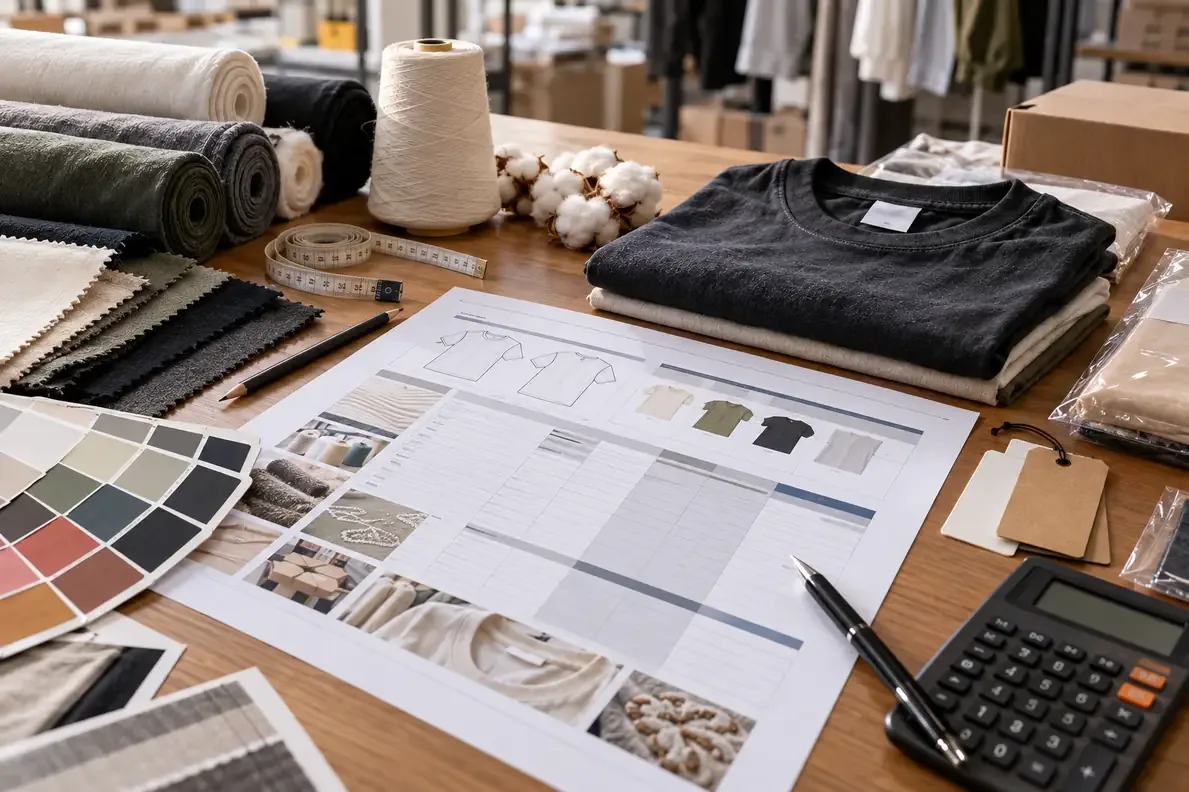
When you understand the fabric, construction, quantity, decoration, finishing, packaging and commercial assumptions behind the price, you can make a much more meaningful comparison between suppliers.
For international clothing brands, this can also reduce surprises later during sampling and bulk production.
A professional manufacturer should be able to explain the major assumptions behind its quotation rather than simply sending a number.
At Texora Sourcing, we work with international buyers to coordinate fabric sourcing, garment development, production, printing, embroidery, finishing, quality control and export requirements from Tiruppur, India.
Looking for a Clothing Manufacturer Quote?
If you are developing a new clothing collection, send us your tech pack, reference images, product specifications, estimated quantity and destination market.
Our team can review the requirements, identify the major production variables and help determine the appropriate manufacturing route before sampling or bulk production.
Request a Clothing Manufacturing Quote from Texora Sourcing.
FAQ
A manufacturer typically needs information such as the garment type, fabric composition, GSM, quantity, colour, size breakdown, measurements, printing or embroidery requirements, labels, packaging, delivery destination and required timeline.
A manufacturer can provide an initial estimate from a photograph, but a more accurate clothing manufacturer quote generally requires additional information such as fabric, measurements, construction, quantity and decoration requirements.
Different manufacturers may use different fabric sources, production methods, quality specifications, quantities, packaging requirements or commercial terms. Always compare quotations based on the same specifications.
Fabric, GSM, garment consumption, construction, quantity, colour, printing, embroidery, washing, accessories, packaging, quality requirements and commercial terms can all affect clothing manufacturing cost.
Provide a detailed tech pack or as much product information as possible, including fabric, GSM, measurements, quantities, colours, decoration, packaging and destination market. The clearer the specification, the more accurately a manufacturer can calculate the production cost.
Not always. A manufacturer can begin with reference images, sketches, measurements or an existing sample. However, a detailed tech pack can reduce assumptions and make the quotation more precise.
A clothing manufacturer quote describes the price and assumptions for producing the garment. An FOB price is a specific international trade price that includes the agreed costs up to the FOB delivery point. Buyers should always confirm exactly what is included in a quoted price.
The lowest quotation is not necessarily directly comparable with a higher quotation. First check whether both manufacturers are using the same fabric, construction, decoration, packaging, quality requirements, delivery terms and other specifications.