
A garment can have the right fabric, fit, stitching and construction-but the final product can still feel completely different depending on how it is finished.
That is where garment finishing plays an important role.
Garment finishing is the stage of apparel production where specific treatments are applied to improve or modify a garment’s appearance, softness, hand-feel, colour, texture, performance, structure or overall character.
For export buyers, garment finishing is more than simply choosing a “wash.” The finishing process can affect shrinkage, measurements, colour, GSM, durability, hand-feel and consistency between pieces.
For example, the same 100% cotton T-shirt can be developed as a clean premium basic, a soft washed T-shirt, a heavily faded streetwear garment or a vintage-style piece simply by changing the finishing approach.
At Texora Sourcing, we coordinate fabric sourcing, garment development, washing and finishing requirements for export-oriented apparel programs, helping buyers translate a desired product appearance into a production-ready specification.
What Is Garment Finishing?
Garment finishing refers to the processes used after or during garment manufacturing to achieve the required final appearance, feel or performance.
Depending on the product, garment finishing can be used to:
- Improve softness and comfort
- Create a vintage or worn appearance
- Reduce surface hairiness
- Improve the appearance of the fabric surface
- Create fading and colour variation
- Improve drape and hand-feel
- Control dimensional changes
- Add moisture-management properties
- Improve stain resistance
- Create fashion effects
- Add structure or stiffness
- Improve the overall retail appearance of the garment
Garment finishing is a broad category. Garment washing is one part of garment finishing, while treatments such as silicone, softener, moisture-wicking and antibacterial finishes can serve different purposes.
24 Types of Garment Finishing
Different washing and finishing units may use different terminology for specialised processes. The exact recipe and result also depend on the fabric composition, GSM, yarn, dye, garment construction, colour and desired final appearance.
Here are 24 finishing processes and effects that apparel buyers may encounter during product development.
1. Acid Wash
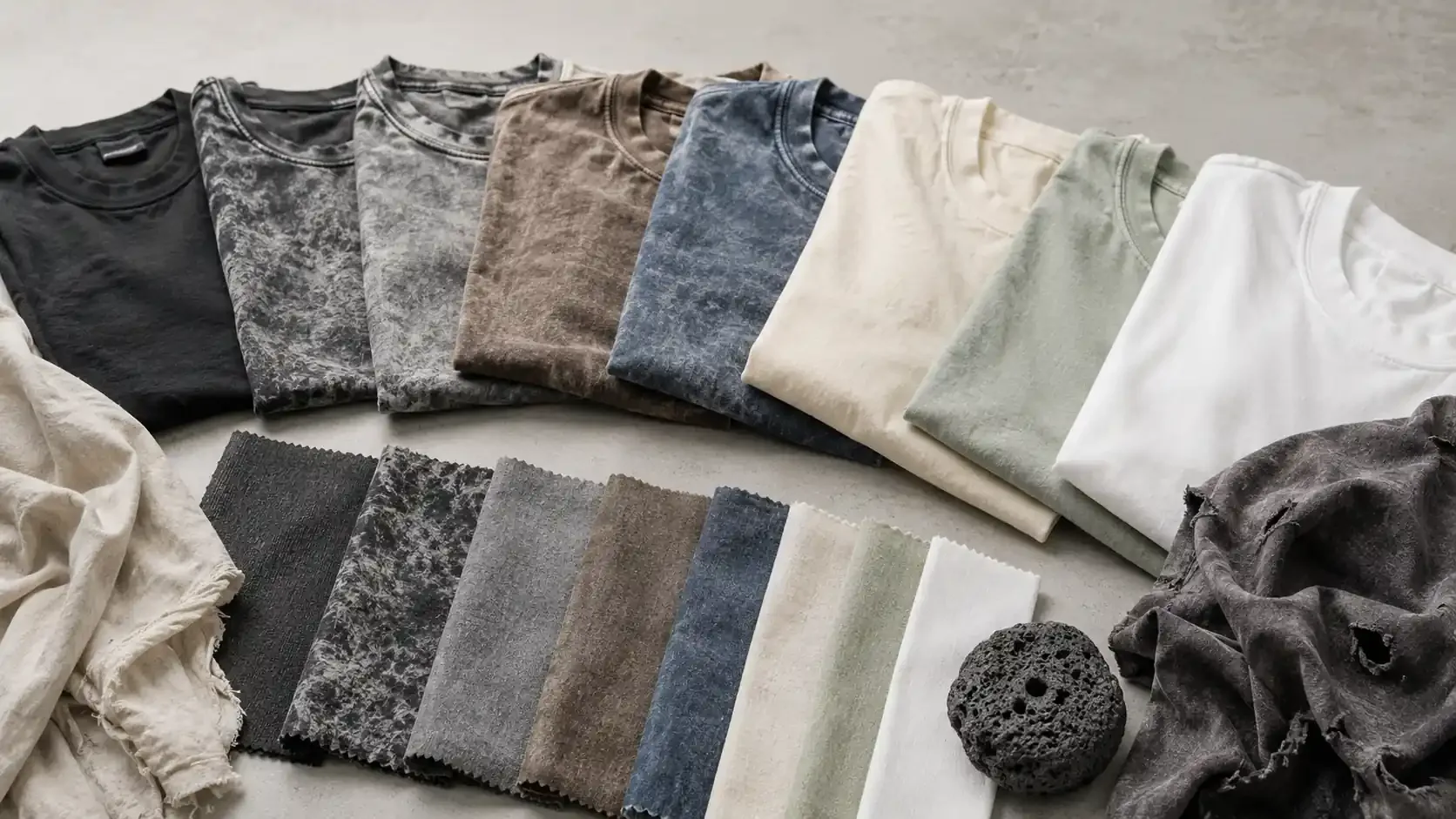
Acid washing creates a distinctive faded and irregular appearance with contrasting areas of colour.
It is commonly associated with denim and fashion apparel, but acid-style effects can also be developed on suitable cotton garments.
Because the effect is intentionally irregular, buyers should approve a physical sample and clearly define the acceptable level of variation before bulk production.
Common applications: Streetwear, denim, oversized T-shirts and fashion collections.
2. Bio Wash
Bio washing uses enzymes to modify the surface of suitable fibres, particularly cellulosic fibres such as cotton.
The process can help reduce surface hairiness and produce a smoother, cleaner and softer hand-feel.
Bio washing is particularly useful when a buyer wants a premium cotton garment without creating an aggressive faded appearance.
Common applications: Premium T-shirts, cotton knitwear, denim and casualwear.
3. Burnout Wash
Burnout is used to create a distinctive surface effect by selectively removing certain fibres from a fabric.
Depending on the fabric construction and fibre composition, the result can create areas of transparency, contrast or a patterned appearance.
Common applications: Fashion tops, lightweight garments and speciality fashion collections.
4. CPD
CPD is a specialised finishing term used in some apparel processing environments.
Because terminology can differ between washing units, export buyers should not rely on the process name alone. A physical reference, approved sample and clear appearance specification are more reliable when developing a particular effect.
Common applications: Specialised garment finishing programs.
5. Crushing
Crushing creates a deliberately irregular, creased or textured appearance.
The effect can give garments a relaxed, distressed or fashion-oriented character and is generally selected for aesthetic purposes rather than basic garment softening.
Common applications: Fashion apparel, casualwear and textured garments.
6. Denim Wash
Denim washing is not one individual process. It can include different combinations of enzyme, stone, bleach, acid and other treatments.
The objective can range from simply softening denim to creating strong fading, worn areas and vintage effects.
Common applications: Jeans, denim jackets, denim shirts and fashion denim.
7. Optic Wash
Optic finishing is generally used to influence the visual appearance of a garment, such as its brightness, cleanliness or surface appearance.
The exact effect depends on the fabric, colour and process used.
For export development, the intended result should be established through sampling rather than relying solely on the process name.
Common applications: Fashion basics and garments requiring a cleaner visual appearance.
8. Moisture-Wicking Finish
Moisture-wicking finishing is designed for garments where moisture management and wearer comfort are important.
The objective is to help move moisture away from the skin and support faster moisture spreading or drying, depending on the fabric and finish.
Unlike purely aesthetic washes, this is a performance-oriented garment finishing process.
Common applications: Activewear, sportswear, training T-shirts and performance apparel.
9. Stain-Removing / Stain-Resistant Finish
Specialised finishes can be developed to improve a garment’s resistance to staining or make certain stains easier to remove.
The exact performance depends on the chemistry, fabric and intended application.
For export buyers, any stain-resistant claim should be supported by the appropriate testing method before being used for commercial marketing.
Common applications: Workwear, uniforms, activewear and performance garments.
10. Roll Wash / Natural Dryer
Roll washing and controlled drying processes can contribute to a softer, relaxed or naturally aged appearance.
The final result depends on the fabric, washing conditions, mechanical action and drying method.
Common applications: Casualwear, vintage-inspired products and relaxed garments.
11. Bio Wash - Dust Removal
A bio washing process can also be incorporated into a finishing program where the objective is to clean the garment surface and reduce loose fibres or dust.
The result can be a cleaner-looking garment with an improved hand-feel.
Common applications: Cotton T-shirts, premium basics and knitwear.
12. CPL Wash
CPL is a specialised terminology used in some garment processing environments.
Since specialised washing terminology can vary between suppliers and regions, international buyers should always define the expected result rather than specifying only an unfamiliar process name.
A reference garment, approved sample and measurable quality requirements help eliminate interpretation differences.
Common applications: Specialised fashion-wash programs.
13. Elastomeric Wash
Elastomeric finishing may be considered for garments containing stretch fibres where the desired outcome involves the garment’s stretch behaviour, recovery or hand-feel.
The process needs to be selected according to the fibre composition and construction.
Common applications: Stretch T-shirts, activewear, leggings and stretch garments.
14. Enzyme Wash
Enzyme washing is one of the most commonly used garment finishing techniques for cotton-based apparel.
Enzymes act on the surface of suitable fibres to create a smoother and softer feel and can contribute to a controlled washed appearance.
Compared with aggressive mechanical abrasion, enzyme treatments can offer a more controlled surface effect when properly developed.
Common applications: Cotton T-shirts, denim, sweatshirts, French terry and casualwear.
15. Fixing Wash
Fixing treatments are used when maintaining colour stability is an important requirement.
The objective can be to improve colour fixation and reduce unwanted colour loss or bleeding, depending on the fabric and dye system.
This is particularly important for garments using dark, bright or challenging shades.
Common applications: Coloured garments, dark T-shirts, fashion apparel and products requiring good colour fastness.
16. GSM Increase Finish
Certain finishing processes can influence the apparent GSM, structure, density or hand of a fabric.
However, buyers should be careful when specifying “GSM increase” as a finishing requirement.
GSM can be influenced by fabric relaxation, moisture, dimensional changes and finishing conditions. Therefore, the final GSM should be measured using a consistent testing procedure and agreed specification.
Common applications: Selected knitwear and garments where final fabric weight and body are important.
17. Hot and Cold Wash
Controlled hot and cold washing conditions can be incorporated into a finishing recipe to influence shrinkage, hand-feel, colour and dimensional stability.
Temperature is particularly important for cotton garments because inappropriate washing conditions can significantly affect final garment measurements.
Common applications: Cotton knitwear, T-shirts, casualwear and garments requiring controlled dimensional stability.
18. Perfume Wash
Perfume finishing adds a fragrance effect to the finished garment.
The fragrance should be selected and approved during development because the perceived strength can change after drying, storage, transportation and exposure to the environment.
For export programs, buyers should also consider whether the fragrance needs to remain detectable after a defined storage period.
Common applications: Lifestyle apparel, fashion collections and premium retail garments.
19. Stone Wash
Stone washing uses mechanical abrasion to create a softer and more worn appearance.
The process can create fading and highlight areas such as seams, hems and other parts of the garment that receive greater mechanical action.
Because the process introduces abrasion, the fabric construction and strength should be considered before production.
Common applications: Denim, heavyweight T-shirts, sweatshirts, French terry and vintage apparel.
20. Stiffening Finish
Stiffening finishes are used when the garment requires additional body, firmness or structure.
This is essentially the opposite objective of a softening treatment.
The finish can help create a more rigid or structured appearance where required by the product design.
Common applications: Structured fashion garments, jackets and garments requiring additional body.
21. Silicone Finish
Silicone finishing is commonly used to improve the softness and smoothness of textiles.
It can produce a more refined hand-feel and improved surface sensation, making it popular for premium garments where comfort is a major part of the product experience.
Common applications: Premium T-shirts, knitwear, loungewear and fashion basics.
22. Softener Wash
Softener treatments are used to improve the softness and comfort of a finished garment.
The correct level is important. Excessive softening can sometimes change the intended hand-feel or influence other fabric characteristics.
The finish should therefore be developed according to the fabric and target product rather than simply requesting the “softest possible” result.
Common applications: T-shirts, loungewear, children’s clothing, underwear and everyday basics.
23. Vintage Wash
Vintage wash is better understood as a design direction rather than one single chemical process.
A vintage appearance can be developed through combinations of enzyme washing, mechanical abrasion, controlled fading, softening and other treatments.
The objective is generally to make the garment look naturally aged, worn and lived-in.
Common applications: Oversized T-shirts, streetwear, hoodies, sweatshirts and vintage collections.
24. Antibacterial Finish
Antibacterial finishing is intended to provide antimicrobial properties to the textile.
For export apparel, this type of finish requires additional attention because a commercial “antibacterial” claim should be supported by appropriate testing and documentation.
The buyer should define the required performance standard and test method before bulk production.
Common applications: Activewear, sportswear, uniforms and performance apparel.
Garment Finishing vs Garment Washing: What Is the Difference?
These two terms are often used interchangeably, but they are not exactly the same.
Garment washing generally refers to wet-processing treatments used to clean, soften, fade or mechanically alter a garment.
Garment finishing is the broader category.
For example:
Enzyme wash → modifies the surface and can improve softness.
Stone wash → creates mechanical abrasion and a worn appearance.
Silicone finish → improves softness and surface feel.
Moisture-wicking finish → adds a performance characteristic.
Stiffening finish → increases body or structure.
Therefore, a garment may undergo one finishing treatment or a combination of several processes.
What Should an Export Buyer Specify?
One of the most common problems in garment development is specifying only the name of a finish.
For example, saying “vintage wash” does not tell a manufacturer exactly how the finished garment should look.
Different processing units may interpret the same terminology differently.
For better results, an apparel buyer should provide:
- Fabric composition – for example, 100% cotton or 95% cotton / 5% elastane.
- GSM – because different fabric weights react differently.
- Garment colour – preferably with a Pantone reference where applicable.
- Required finish – enzyme, stone, acid, vintage, silicone, etc.
- Reference image or physical garment – especially for fashion effects.
- Desired hand-feel – soft, dry, crisp, smooth, rigid, brushed, etc.
- Expected appearance – clean, faded, vintage, marbled or distressed.
- Post-finish measurements – including acceptable tolerances.
- Colour fastness requirements.
- Acceptable piece-to-piece variation.
A physical reference is particularly valuable when developing fashion washes because the buyer and manufacturer can evaluate the actual result instead of interpreting terminology differently.
Why Sampling Is Critical in Garment Finishing
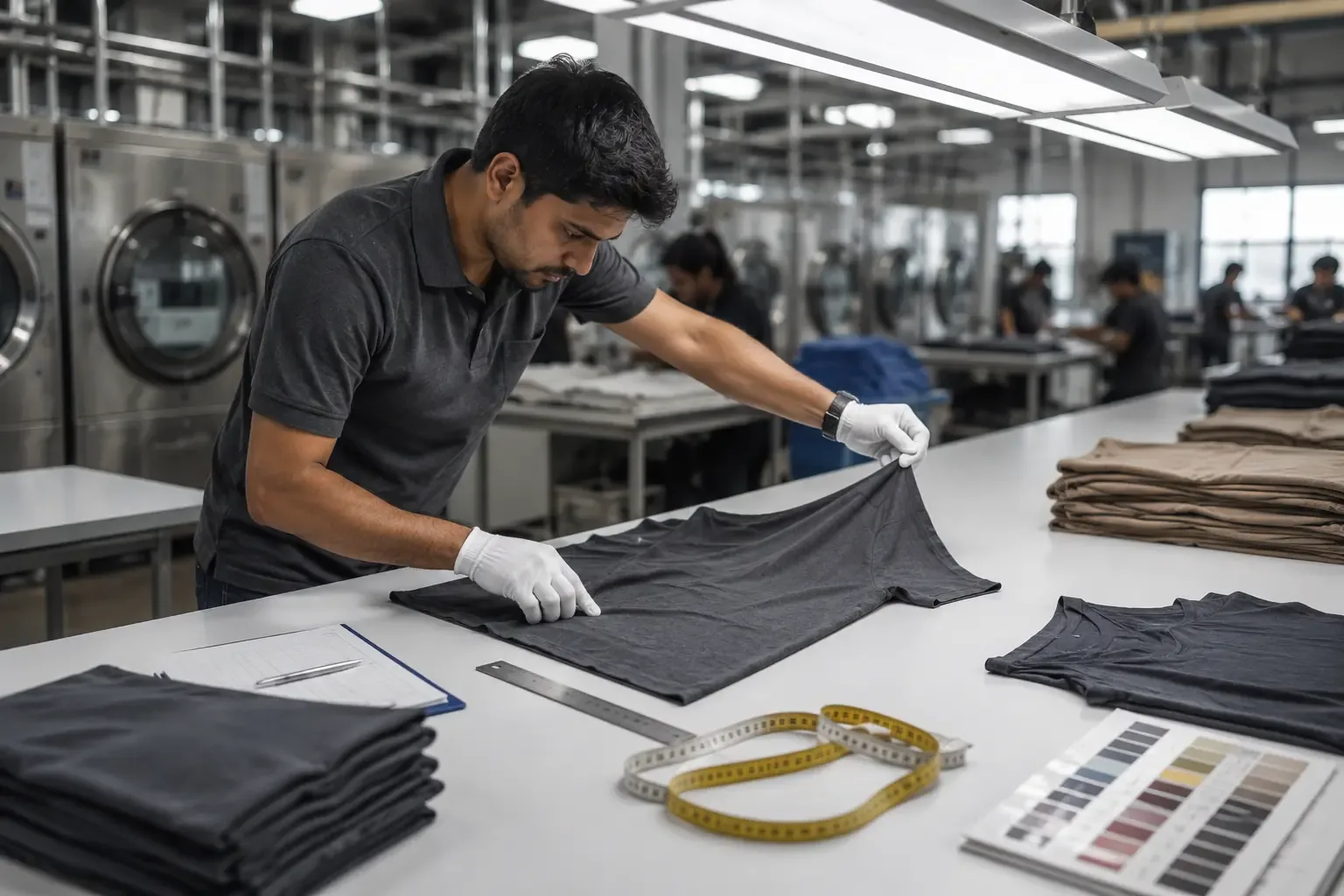
Garment finishing should be finalised before bulk production, especially when the treatment can affect measurements, shrinkage, colour, GSM or hand-feel.
A practical development sequence is:
Tech Pack → Fabric Selection → Garment Construction → Finishing Trial → Measurement Check → Approval → Pre-Production Sample → Bulk Production → Final Inspection
The approved sample should become the physical benchmark for bulk production.
For washed garments, measurements should be checked after the final finishing process. This is especially important for cotton garments because washing and drying can change the final dimensions.
A garment that measures perfectly before washing may not have the same measurements after the finishing process.
Which Garment Finish Is Right for Your Product?
The appropriate finish depends on the product’s intended appearance, fabric and market.
| Product | Possible Finishing Options |
|---|---|
| Premium T-shirt | Bio wash, enzyme, softener, silicone |
| Oversized streetwear T-shirt | Vintage, enzyme, acid, stone |
| Denim | Stone, enzyme, acid and other denim washes |
| Hoodie | Vintage, enzyme, softener, stone |
| French Terry | Enzyme, softener, vintage |
| Activewear | Moisture-wicking, antibacterial |
| Loungewear | Softener, silicone, bio wash |
| Workwear | Stain-resistant and performance finishes |
| Fashion garments | Acid, crushing, burnout, vintage |
| Structured garments | Stiffening finish |
The important point is that there is no universally “best” garment finish.
The right process is the one that achieves the required appearance and performance without compromising the garment’s construction, measurements or commercial quality.
Key Quality Checks After Garment Finishing
For export orders, finishing should be evaluated from both an aesthetic and technical perspective.
Important checks can include:
- Final garment measurements
- Shrinkage
- Colour fastness
- Shade consistency
- GSM
- Hand-feel
- Surface appearance
- Fabric strength
- Print appearance, where applicable
- Performance claims
- Piece-to-piece variation
- Overall garment appearance
This is why garment finishing should not be treated as the final cosmetic step.
It is part of the product development and quality-control process.

Final Takeaway
Garment finishing can completely change the identity of an apparel product.
A basic cotton T-shirt can become soft and premium, faded and vintage, heavily distressed, structured or performance-oriented depending on the finishing process selected.
For international apparel buyers, the goal should not simply be to select a popular wash. The finishing process needs to match the fabric, garment construction, target market, desired appearance and performance requirements.
From enzyme and stone washing to silicone, vintage, moisture-wicking and antibacterial treatments, garment finishing gives brands greater control over the final product.
Most importantly, the process should be developed through sampling, measurable specifications and an approved production reference before bulk manufacturing begins.
If you are developing T-shirts, oversized apparel, hoodies, loungewear, activewear, denim or private-label clothing, discussing garment finishing at the development stage can help avoid costly corrections later.
Texora Sourcing supports export apparel buyers with fabric sourcing, garment development, manufacturing coordination, finishing requirements, quality control and export production from India.
Looking for a specific garment finish for your next collection? Share your tech pack, reference garment or desired finish with our sourcing team.